Back to blogWhy Peer Comps Break
InsightsThe PitchFit Premise5 min readJun 9, 2026

Why Peer Comps Break

Your Peer Comparison Is Probably Wrong. Here's Where It Breaks.

A peer comp looks like the most objective slide in the deck. Five companies, four metrics, one tidy table. Margins to one decimal place. It radiates rigor.

Having built, audited, and argued about more of these than I would like to admit across restructurings, due diligence and transformation programs, I can tell you where that confidence quietly falls apart. Not in the arithmetic. The arithmetic is always right. It falls apart in the basis: a handful of unglamorous, structural problems that sit underneath every cross-company comparison, and that most decks never disclose because the person presenting often does not know they are there.

Here are the five that do the most damage.

1. The same label, different contents

"Cost of revenue" is not a defined term. Neither, in practice, is "SG&A," "other operating income," or half the lines on a P&L. Accounting standards constrain recognition and measurement far more tightly than they constrain presentation, so two companies in the same industry can put the same economic cost in different places and both be fully compliant. Delivery costs sit in COGS at one retailer and in opex at another. Development costs are capitalized here and expensed there. R&D is shown gross at one pharma company and net of credits at its peer.

When we surveyed 500+ professionals who work with company financials, this was the single most cited obstacle to comparison: 1 in 2 named it, rising to 57% of those doing the work weekly. The implication is brutal for a comp table. A two-point gross margin gap between two companies may be telling you about classification policy, not operating performance. Unless someone has reclassified both companies onto one framework, the table is comparing labels, not economics.

2. Fiscal years that don't line up

Company A closes in December. Company B closes in March. Company C, because it is a retailer, closes on the Saturday nearest the end of January. Put their "FY2024" side by side and you are comparing periods that can be a full quarter apart, and in a fast-moving year, an entire demand cycle apart. Currency moves, commodity prices, even a single strong holiday season land in different fiscal years for different companies.

Calendarisation, the work of rebuilding companies onto a common twelve-month window from quarterly data, fixes this, and roughly one in three professionals in our survey named it as a pain point before any comparison can begin. It is tedious, it is error-prone when done by hand, and it is skipped more often than anyone admits. If a comp does not state the basis period for each company, assume it has not been done.

3. Adjustments made once, applied inconsistently

Every serious comparison involves judgment: stripping one-offs, normalizing for restructuring charges, deciding whether that legal settlement is recurring in character or genuinely exceptional. The judgment is unavoidable. The damage comes from applying it asymmetrically, adjusting your target company carefully because you know it well while taking the peers' headline figures as published. The target ends up flattered or punished by nothing more than attention.

The honest rule is simple to state and rarely followed: any adjustment you make to one company, you must investigate for every company in the set. That is exactly the kind of disciplined, repetitive work humans do badly at 11pm before a deadline, which is why it belongs in a standardized framework, not in fourteen tabs of a workbook.

4. The provider data you didn't reconcile

Aggregated data platforms are extraordinary feats of coverage, and they are also the output of someone else's standardization choices, choices you usually cannot see and did not make. In our survey, respondents reported struggling to reconcile provider data back to the source filings, expressed doubts about third-party accuracy, and flagged the missing audit trail from a number to its origin. Taken together, nearly 3 in 4 flagged at least one of these trust issues.

The practical failure mode: a number is challenged in a meeting, and nobody can trace it. Was it as-reported or adjusted? Which filing, which note, which restatement? A comparison you cannot trace is a comparison you cannot defend, and senior audiences have a good instinct for which is which.

5. The industry nuances that swallow whole comparisons

Some accounting areas are large enough to invert a conclusion on their own. Lease capitalization moved billions between opex and EBITDA, and companies' transition choices still echo through multi-year comparisons. Pension accounting can swing reported profitability for older industrial companies. Hedging and derivative treatment makes two airlines with identical fuel exposure report very different cost lines. About a quarter of our survey respondents named these industry-specific nuances as a core obstacle, and they are the obstacles that generic, one-size-fits-all standardization handles worst, because they require knowing what to look for in each sector's notes.

The fix is boring, and that's the point

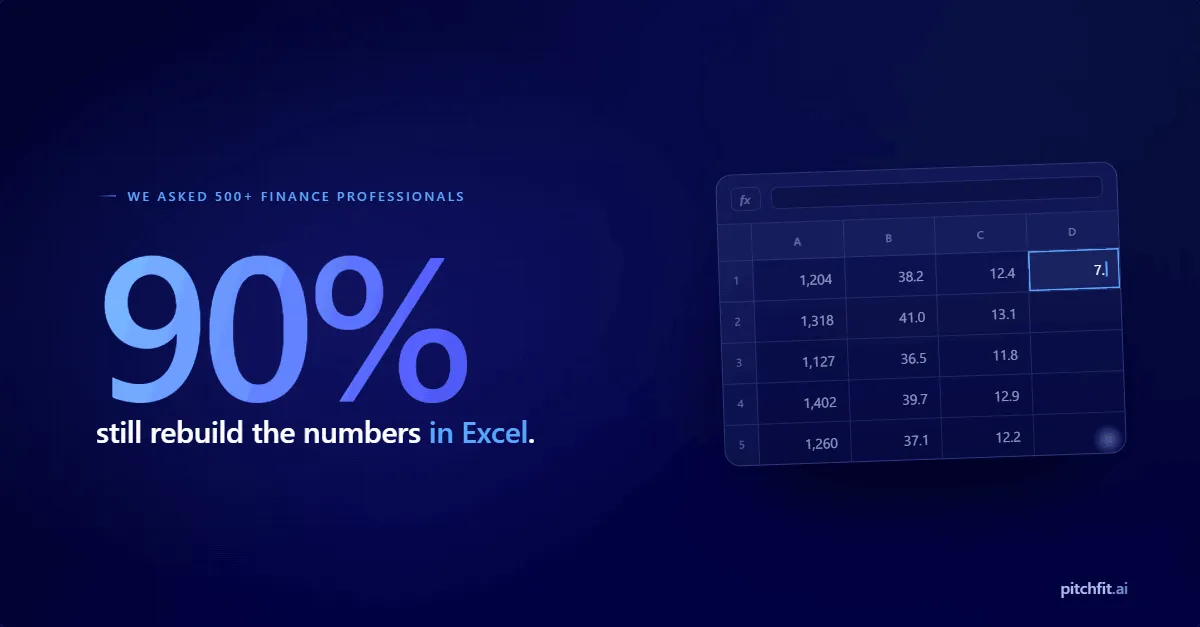
None of these five problems is exotic. Every experienced analyst knows them. The reason they persist is economic: fixing all five, for every company, on every refresh, by hand, costs hours that deadlines do not allow. So corners get cut silently, and the comp table keeps its confident appearance while losing its meaning. Ninety percent of the professionals we surveyed still do this work manually in Excel. The problem is not knowledge. It is that consistency at scale is not a human-shaped task.

This is the entire premise behind PitchFit: standardize every filing onto a single, defensible basis, covering classification, calendarisation, adjustments and sector nuance, once, consistently, with every figure tracing back to its source filing. So the next time someone asks whether these numbers are really comparable, the answer is yes, and you can show them why.

A peer comp should settle arguments, not start them.

PitchFit standardizes every statement one way, with full traceability to source. Early access is opening. Join the waitlist at pitchfit.ai.